Bhutan or the Land of the Thunder Dragon richly and happily celebrates its ancient Buddhist culture through colorful mask dances. Most of the festivals are held in honor of Guru Rinpoche, which falls on the 10th day of the Lunar Bhutan Festival Calendar. Your visit to Bhutan is incomplete if you cannot participate in one of the Bhutan Festivals. So check out the Bhutan Festival dates for 2027 so you can add at least one of the festivals in your Bhutan Tour Itinerary.
Bhutan Festival or Tshechu, the festival of mask dances, is one of the most vibrant legacies of Bhutan’s intangible cultural gems that dates back to as far as the 8th century. An Indian saint, Guru Padmasambhava or Lotus-born, who is credited to have brought the Tantric form of Buddhism to the country, is the propagator of these colorful mask dances.
The mask dance festivals are available throughout the year. So you can always check the Bhutan Festival Calendar below and try to add one in your Bhutan Tour Package.
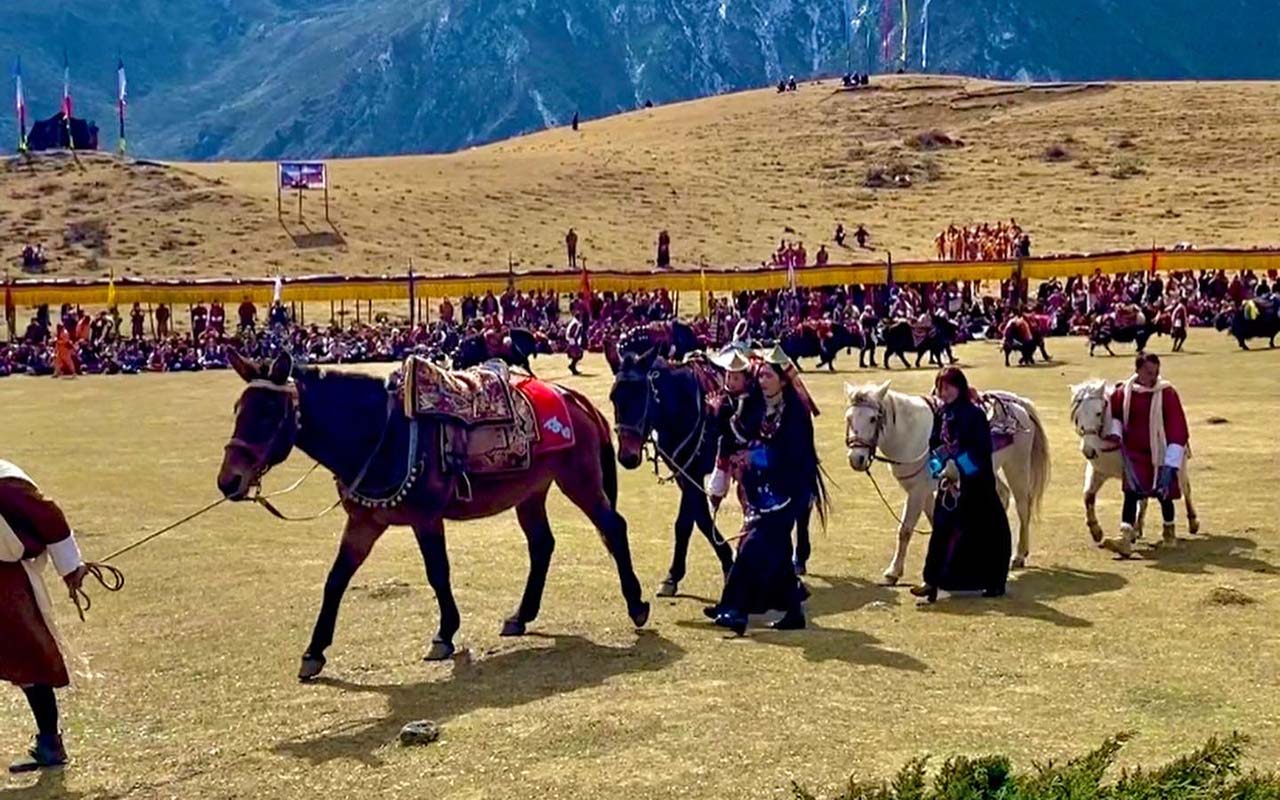
The mask dance festivals celebrate the offset of the harvest season, meaning the barns are full and the skies sunny, or just before the dawn of a new spring season that precedes the bloom and color. The mask dance festival is celebrated as an annual event throughout all 20 districts in the country, and the 3–5 days affair of the Bhutan Festival Calendar generally concludes with the unfurling of the Thongdrel, a giant Buddhist applique, that is displayed only once in a year and is associated with bringing joy and fulfillment in one’s life.
THINGS TO DO IN BHUTAN FESTIVAL
Bhutanese festivals are a big attraction for solo travelers as well as for families. Especially during these festivals, every Bhutanese coming for celebration wears their finest clothes. You too can try out Bhutanese dress (Gho and Kira) and join the locals. You can also pack picnic lunches and stay all day at the festivals.
DETAIL VIEW OF BHUTAN FESTIVAL CALENDAR 2027
A detailed view of the Bhutan Festival Calendar is below. Try to include one of the festivals in your itinerary if possible so you can enjoy Bhutan’s cultural extravaganza.
Explore the major festivals across Bhutan, their locations, and dates. Dates are tentative; please confirm with us before you book.
| FESTIVAL | PLACE | DATE |
|---|---|---|
| Lhamoi Dromchhen | Trongsa Dzong, Trongsa | 11th – 13th February |
| Punakha Dromchoe | Punakha Dzong, Punakha | 13th – 15th February |
| Punakha Tshechu | Punakha Dzong, Punakha | 16th – 18th February |
| Tharpaling Thongdrol | Tharpaling Lhakhang, Chumi, Bumthang | 20th February |
| Chhorten Kora | Chorten Kora, Trashiyangtshe | 20th February & 8th March |
| Tangsibi Mani | Tangsibi Lhakhang, Ura, Bumthang | 22nd – 24th February |
| Gomphukora | Gom Kora Lhakhang, Trashiyangtshe | 16th – 18th March |
| Talo Tshechu | Talo Gonpa, Punakha | 16th – 18th March |
| Gasa Tshechu | Gasa Dzong, Gasa | 16th – 18th March |
| Zhemgang Tshechu | Zhemgang Dzong, Zhemgang | 16th – 18th March |
| Paro Tshechu | Rinpung Dzong, Paro | 18th – 22nd March (Thongdral on last day) |
| Rhododendron Week | Shetemey, Merak, Trashigang | 3rd – 9th April |
| Domkhar Tshechu | Domkhar, Chumi, Bumthang | 16th – 18th April |
| Ura Yakchoe | Ura Lhakhang, Bumthang | 18th – 22nd April |
| Rhododendron Festival | Lamperi Botanical Park, Thimphu | 22nd – 23rd April |
| Nimalung Tshechu | Nimalung Dratshang, Chumi, Bumthang | 12th – 14th June |
| Kurjey Tshechu | Kurjey Lhakhang, Choekhor, Bumthang | 14th June |
| Tour of the Dragon (Mountain Bike Race) | Bumthang to Thimphu | 5th September |
| Thimphu Drubchen | Tashi Chhodzong, Thimphu | 5th October |
| Wangdue Tshechu | Wangduephodrang | 8th – 10th October |
| Tamshing Phala Chhoepa | Tamshing Lhakhang, Bumthang | 10th – 12th October |
| Thimphu Tshechu | Tashi Chhodzong, Thimphu | 10th – 12th October |
| Gangtey Tshechu | Gangtey Gonpa, Wangduephodrang | 13th – 15th October (Thongdral on last day) |
| Jhomolhari Mountain Festival | Dangochong, Thimphu | 14th – 15th October |
| Thangbi Mewang | Thangbi Lhakhang, Choekhor, Bumthang | 15th – 16th October |
| Haa Tshechu | Lhakhang Karpo, Haa | 6th – 8th November |
| Pemagatshel Tshechu | Pemagatshel Dzong, Pemagatshel | 6th – 9th November (Thongdral on last day) |
| Chhukha Tshechu | Chhukha Dzong, Chhukha | 6th – 8th November |
| Jakar Tshechu | Jakar Dzong, Choekhor, Bumthang | 6th – 9th November |
| Dechenphu Tshechu | Dechenphu Lhakhang, Thimphu | 8th November |
| Black Necked Crane Festival | Gangtey Gonpa, Phobjikha, Wangduephodrang | 11th November |
| Jambay Lhakhang Drup | Jambay Lhakhang, Choekhor, Bumthang | 14th – 17th November |
| Prakhar Duchhoed | Prakhar Lhakhang, Chumi, Bumthang | 15th – 17th November |
| Goenpai Drupchen | Trongsa Dzong, Trongsa | 3rd – 5th December |
| Mongar Tshechu | Mongar Dzong, Mongar | 6th – 8th December |
| Phuntsholing Tshechu | Phuntsholing, Chhukha | 6th – 8th December |
| Trashigang Tshechu | Trashigang Dzong, Trashigang | 7th – 9th December |
| Jambay Lhakhang Singye Cham | Jambay Lhakhang, Choekhor, Bumthang | 13th December |
| Nalakhar Tshechu | Ngaa Lhakhang, Choekhor, Bumthang | 13th – 15th December |
| Druk Wangyel Tshechu | Douchula, Thimphu | 13th December |
| Trongsa Tshechu | Trongsa Dzong, Trongsa | 5th – 9th January 2028 (Thongdral on last day) |
| Lhuentse Tshechu | Lhuentse Dzong, Lhuentse | 5th – 9th January 2028 (Thongdral on last day) |
| Samdrupjongkhar Tshechu | Samdrupjongkhar | 10th – 12th January 2028 |
| Nabji Lhakhang Drup | Nabji Lhakhang, Nabji, Trongsa | 12th – 14th January 2028 |
CLIMATIC CONDITION IN BHUTAN
The climate in Bhutan is extremely varied. This variation in the climatic conditions and average temperature can be attributed to two main factors: the vast differences in altitude present in the country and the influence of the north Indian monsoons. Southern Bhutan has a hot, humid sub-tropical climate that is fairly unchanging throughout the year. Temperatures can vary between 15–30 degrees Celsius. In the central parts of the country, the climate cools a bit, changing to temperate and deciduous forests with warm summers and cool, dry winters. In the far northern reaches of the kingdom, the weather is cold during winter. Mountain peaks are perpetually covered in snow and lower parts are still cool in summer owing to the high-altitude terrain.
The Indian summer monsoon lasts from late June through late September and is mostly confined to the southern border region of Bhutan. It brings heavy rain and high humidity to the southern region. These rains bring between 60 and 90 percent of the western region’s rainfall.
Annual precipitation ranges widely in various parts of the country. The northern border region to Tibet gets about forty millimeters of precipitation a year, primarily snow. In the temperate central regions, a yearly average of around 1,000 millimeters is more common, and 7,800 millimeters per year has been registered at some locations in the humid, subtropical south, ensuring thick tropical forests or savanna.
Thimphu experiences dry winter months (December through February) and almost no precipitation until March, when rainfall averages 20 millimeters a month and increases steadily thereafter to a high of 220 millimeters in August for a total annual rainfall of nearly 650 millimeters.
Bhutan’s generally dry spring starts in early March and lasts until mid-April. Summer weather commences in mid-April with occasional showers and continues to late June. The heavier summer rains last from late June through late September which is more monsoonal along the southwest border.
Autumn, from late September or early October to late November, follows the rainy season. It is characterized by bright, sunny days and some early snowfalls at higher elevations.
From late November until March, winter sets in, with frost throughout much of the country and snowfall common above elevations of 3,000 meters. The winter northeast monsoon brings gale-force winds at the highest altitudes through high mountain passes, giving Bhutan its name – Drukyul, which in the Dzongkha language means Land of the Thunder Dragon.
SEASON AND CLIMATE IN BHUTAN
Bhutan has a season for everyone. The kingdom stretches across three climatic zones – from the sub-tropical jungles in the south, to the moderate heights of 2000–2500 meters in the centre and up to the alpine world of the towering Himalayas. Temperatures in the central valleys do not normally exceed 30°C in the summer and in the winter around 15°C during the day.
Spring is a botanist’s delight as rhododendrons, wild azaleas, and masses of wild flowers including the edelweiss cover the meadows like carpet. Pear and apple blossoms add a dainty touch to the valleys as their pink and white blooms add a sense of new wonder to the land.
Summer is an abundant time of the year as flowers are in bloom and valleys are covered in green. Weeping willows sweep the banks of many rivers and pine cones glisten in the sun, so full of resin they are ready to plummet to the ground.
Autumn casts a bright golden glow on the vast landscape. The rice fields ripen to a golden brown under crisp blue skies. The merry pink and white of cosmos flowers dot the countryside.
Winter has its moments. The days are full of sunshine while evenings can turn chilly. Soft turfs of clouds drape lazily over mountain tops as if waiting for new life to blow it across the landscape.
Monthly average maximum and minimum temperatures (°C) for major cities in Bhutan.
| Month | Values | Paro | Thimphu | Punakha | Trongsa | Bumthang | Mongar | Trashigang |
|---|---|---|---|---|---|---|---|---|
| January | Max | 9.4 | 12.3 | 17 | 13 | 10.8 | 15.5 | 20.4 |
| January | Min | -5.8 | -2.6 | 4.3 | -0.2 | -5.1 | 8.2 | 10.5 |
| February | Max | 13 | 14.4 | 19 | 13.9 | 10 | 15.9 | 21.7 |
| February | Min | 1.5 | 0.6 | 7.8 | 0.4 | -1.4 | 8.3 | 11.5 |
| March | Max | 14.5 | 16.4 | 22.8 | 16.7 | 16.2 | 20 | 24.8 |
| March | Min | 0.6 | 3.9 | 10.4 | 4.4 | 3.5 | 11.6 | 14.4 |
| April | Max | 17.6 | 20 | 26.2 | 20.1 | 18.7 | 22.8 | 28.3 |
| April | Min | 4.6 | 7.1 | 12.9 | 6.6 | 3.9 | 14 | 17 |
| May | Max | 23.5 | 22.5 | 29.1 | 21 | 21.3 | 25.1 | 30 |
| May | Min | 10.6 | 13.1 | 17.7 | 11.6 | 9.5 | 17.4 | 22.6 |
| June | Max | 25.4 | 24.4 | 29.2 | 22.2 | 22.5 | 26.1 | 30.7 |
| June | Min | 14.1 | 15.2 | 20.1 | 13.6 | 13.5 | 19.5 | 22.6 |
| July | Max | 26.8 | 25.9 | 30.4 | 25.3 | 24.1 | 27.1 | 31.5 |
| July | Min | 14.9 | 15.6 | 20.5 | 15.3 | 13.6 | 19.8 | 23.1 |
| August | Max | 25.3 | 25 | 29.1 | 23.8 | 23 | 25.4 | 30.2 |
| August | Min | 14.7 | 15.8 | 20 | 15 | 13.7 | 19.6 | 22.7 |
| September | Max | 23.4 | 23.1 | 27.5 | 22.6 | 21.6 | 24.7 | 30 |
| September | Min | 11.7 | 15 | 19.1 | 14.2 | 12.1 | 19.4 | 21.9 |
| October | Max | 18.7 | 21.9 | 26.1 | 21.8 | 19.5 | 22.7 | 29.1 |
| October | Min | 7.4 | 10.4 | 14.7 | 11.7 | 5.9 | 15.8 | 17.7 |
| November | Max | 13.9 | 17.9 | 22.6 | 19.8 | 16.1 | 19.9 | 26.1 |
| November | Min | 1.4 | 5 | 9.6 | 6.4 | -0.5 | 11.2 | 13.6 |
| December | Max | 11.2 | 14.5 | 19.1 | 18.2 | 12.3 | 17.7 | 23 |
| December | Min | -1.7 | -1.1 | 6.3 | 2.5 | -2.3 | 9.5 | 11.6 |
Bhutan is a mesmerizing country with high mountains and lush green topology. With newly constructed roads and bridges, transport now runs on well-developed networks. The major motorway runs west-east with other connecting roads that link to the southern border, making the northern portion of the nation and many other sections of the country only accessible by hike. Atijong Tours and Travels drivers are all certified and well-versed in their homeland. They are cautious drivers. On most roadways, traffic density is typically modest.
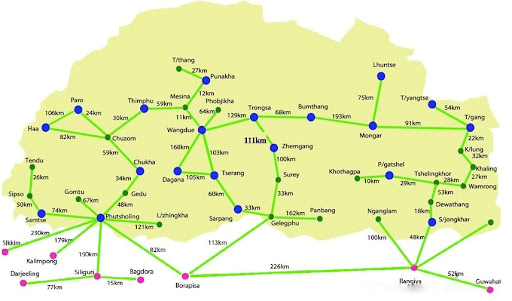
Bhutan is a landlocked nation with terrain dominated by steep mountains and hills. As a result, sea transportation and train travel are not viable options to cover the Bhutan Distance. Domestic flights operate between Paro (Western Bhutan), Bumthang (Central Bhutan), Gelephu (Mid-South), and Yonphula (Eastern Bhutan) to cover the Bhutan Distance.
The major means of transportation, however, is via road. Despite its high mountains, steep slopes, and deepest valleys, the country has a well-developed road network that overcomes the Bhutan Distance. However, it is unusual to come across a stretch of road that is both straight and flat. Some segments include as many as six to seven turns every kilometer! Road travel in Bhutan is marked by steep ascents and descents, as well as twisting and narrow roads, which can make travel considerably slower than one might expect. The average speed for road travel is roughly 45 kilometers per hour, although the pace is slower due to the many pauses made by tourist vehicles. The breathtaking vistas of towering mountains, lush green jungle, old towns, and beautiful monasteries compensate amply for the lengthy and often exhausting vehicle drive.
Our transport includes coaster buses, 4WD vehicles, and cars like Creta, Tucson, or Santa Fe. Enjoy steep ascents and descents, wide and narrow roads, and beautiful scenic beauty covering the vast land of Bhutan. Check out the Bhutan Distance Chart below.
On the hiking trip, you will be hiking five to six hours a day, up and down mountain trails that are sometimes steep, and mostly at elevations above 10,000 feet. Exercise at high altitude compounds physiologic stress. In addition, high altitude may create discomfort and symptoms of illness that you do not experience while exercising at lower elevations, such as shortness of breath, restlessness or sleeplessness at night, and headaches. You need to be in excellent health and top physical condition to enjoy such an experience, with adequate cardiovascular endurance, muscular strength, and excellent balance.
This level of fitness requires regular aerobic exercise for at least one hour 4–5 times a week. This may include aerobic fitness classes, power walking, jogging, and cycling on hills, swimming, and cross-country skiing. Additionally, you must be able to sustain exercise for prolonged periods. Finally, you must have some experience with exercise at altitude.
We recommend that you start a moderate training program several months before departure, then slowly build up to a more strenuous level. Since training is highly sport-specific, include some hiking or running in your program. Consult your physician if you have questions concerning your underlying health. If you have concerns about your capacity to do this trip, we can suggest appropriate alternatives.
If you have hiked at 10,000 feet before, you will probably find that hiking at altitudes higher than that is simply an extension of your previous experience—you’ll walk more slowly, rest more frequently, have some restlessness at night, and be subject to headaches. If your previous reaction to altitude has been nausea or other unpleasant symptoms, trekking in Bhutan may not be for you.
We design each of our treks to maximize altitude conditioning in the early part of the trek. However, be forewarned that there are no guarantees that your body will acclimatize properly. Any trip member who, in the opinion of the trip leader, shows signs of potential acute mountain sickness (such as HAPE—high altitude pulmonary edema) will have no choice but to descend and remain at comfortable altitudes. The decision of the trip leader is final in such matters.
Facilities Provided While You’re On The Trek
While camping, we will be providing sleeping arrangements. A bowl of hot water will be provided in the morning before breakfast and in the afternoon upon your arrival at camp. Bring a sponge or washcloth along and you can have a full sponge bath in your tent! There will be a toilet tent.
Food at camp is plentiful. You will find snacks and hot beverages in the dining tent after settling in at camp in the afternoon. Lunches are on the trail. Our staff will have a warm, simple meal ready for us when we reach our lunch spot. The food served to you in our trekking camps is plentiful and prepared hygienically by a trained, experienced camp staff. We provide boiled water to fill your bottles every evening.
Please Bring The Following Essential Trekking Gears:
Lightweight trousers / Trekking trousers / Tracksuit / Shorts / fleece pants for evenings
Fleece Jacket / Down jacket / Waterproof jacket
Warm Hat / Warm Skull Cap / Neck warmer and Sun Hat
Gloves and Mitts – waterproof and warm
Trekking Boots / Trekking Poles
Camp Shoes
Several pairs of socks
Day Wear T-shirt
Sunglasses with UV protection
Sunscreen and Lip Balm
Lightweight towel
Bring the camera you are most comfortable with. A DSLR or mirrorless camera with a zoom or telephoto lens is ideal for wildlife, dzongs and festival dances, and a modern smartphone is perfect for everyday shots. Lenses longer than 300mm may need a tripod and can be cumbersome to carry. A small tripod or beanbag helps steady the camera during early morning and evening shots.
Carry spare batteries and extra memory cards, as charging is not possible on trek or at camp. Back up your photos regularly, and be familiar with how many images your memory card can store at the resolution you prefer. A power bank is useful for phones and cameras.
Video camera enthusiasts should note that there are no video-charging facilities on trek.
A Word about Photographing People:
The people of Bhutan are very colorful, and their facial features bestow on them a peaceful beauty that is hard to pass up a photographic opportunity. Generally speaking, Bhutanese children love having their picture taken. Most times, as soon as they see your camera, they will run up to you, giggling and fighting among each other for the best position in the tableau. Other times, they may not show such enthusiasm, but if asked politely, they will be more than happy to pose for you. Adults are more reserved and, out of respect, you should always ask permission of your subjects before pointing your camera at them.
Restrictions:
Bhutan is generally liberal about photography by tourists. There are a few places, though, with signs prohibiting photography, such as telecommunication or military areas.
There are no restrictions on photographing the outside of dzongs (fort-monasteries) and goembas (monasteries), but photography is strictly prohibited inside goembas and lhakhangs (temples). Kindly note drones are also not allowed.
For more information, you can check the website of the Bhutan InfoComm & Media Authority: www.bicma.gov.bt/bicmanew.
Laundry:
Laundry service is available at the hotels in Paro and Thimphu.
Electricity:
Bhutan is on the 220V system. Sockets are usually the three-pin variety, but they vary. Bring a converter and a selection of plug adapters. Of course, there won’t be electricity while on camp.
Time Zones:
Bhutan is Greenwich Mean Time plus six hours. That means that Thimphu is eleven hours ahead of New York and fourteen hours ahead of California. Therefore, if it’s 8:00pm in Thimphu, it’s 9:00am in New York and 6:00am in California.
Communications:
Fax machines and telephones are available at most hotels. Keep in mind, however, that telephone calls and faxes from Bhutan are very expensive.
Cross Cultural Tips:
Remember that you are traveling to a foreign country where you are the visitor, and need to adapt to the culture and customs of the local people, not vice-versa. Although most people in the populated areas of Bhutan learn English from an early age, it should not be assumed that everyone you’ll meet understands or speaks it, particularly in the remote villages in the mountains. Should you have difficulty communicating with any of the locals, please ask your local guide for assistance. It is also common for events to arise that place your own cultural beliefs in contrast with those of your hosts. A lot of the comforts you are accustomed to may not be available to you, and time flows at a different pace. Patience and respect are the crucial ingredients for a successful trip and an enriching experience.
Gifts For Children:
We discourage handouts of candy, chewing gum, and other items to the children you meet, whether you’re on trek or in the cities. “Junk food” is dangerous because dental care is just about non-existent in Bhutan, and handouts encourage children to beg. Postcards and pictures are wonderful to bring along to show the locals.
Environmental Responsibility:
We pride ourselves on being an environmentally responsible company. We request that on trek, you carry out whatever you carry in, including non-biodegradable items such as batteries, torch bulbs, empty plastic containers, and so on. The areas of Bhutan that we trek in do not have the proper facilities to process this kind of waste. We suggest that you carry a large Ziploc bag in your backpack while on the trail for daily accumulations, and also keep one in your duffel to store your trash. As you pack for your trip, think about ways to minimize the trash that you will have to bring home.
Visa:
Indian nationals need an e-permit, and Bangladeshi and Maldivian nationals follow the same regional entry process (apply online, through a licensed tour operator such as Ati Jong, or at the port of entry). All other visitors need a Bhutan e-visa. Visas and permits are issued only after a confirmed booking through a licensed Bhutanese tour operator. Contact Ati Jong and we will apply for your visa or permit and confirm the current requirement for your passport.
Currency:
The Ngultrum (Nu) is at par with the Indian Rupee, Please check the current US dollar exchange rate before you travel. Foreign currencies can be changed at the airport and from banks. ATM and banks accept Visa International and MasterCard. Most business outlets in Thimphu, Paro, Punakha, Wangdue, Trongsa, Bumthang, Monggar, Trashigang, and Phuentsholing have Point of Sale terminals.
Accommodation & Fooding:
A wide variety of accommodation is available ranging from luxurious 5-star hotels to cozy homestays in traditional Bhutanese homes. Visitors can be assured of warmth and comfort. Dining out includes Indian, Continental, Chinese, and Bhutanese dishes. Ema Datsi – a cheese and chili dish – is popular among Bhutanese and visitors. Locally produced beer, whisky, and Ara (distilled from rice, barley, or wheat) are also popular.
Shopping:
Bhutan is popular for its textiles, cane and bamboo products. Many shops sell handwoven Bhutanese textiles, handicrafts, thankas, jewellery, antiques, and organic herbal products.
Telecommunications:
Bhutan is well connected. Internet cafes are available almost everywhere. Cell phones can also be used in most places around the country. SIM cards are available at the airport and in most shops.
Additional Cost:
Additional cost is involved if you want to partake in the following activities:
Cycling (USD 40/Cycle/Day)
Basic Painting Class (USD 40/Person/Session)
Meditation Class (USD 30/Person)
Yoga Class (USD 30/Person)
River Rafting In Punakha (USD 150/Raft)
Lesson On Traditional Weaving (USD 30/Person)
Private Cultural Performance (USD 80 for 1 Hour)
We have 2 components of payment:
1. Government SDF + Visa Fee
2. Tour Cost / Land Cost
| Time | Payment |
| At time of reservation | 20% of tour cost |
| 60 days prior to departure | 20% of tour cost |
| 30 days prior to departure / After visa approval | Balance Amount |
In order to get your Bhutan Visa, we have to transfer the SDF/Visa Fee to the Department of Immigration.
• If you are booking tours 60 days or less prior to the departure date, you have to pay Full SDF/Visa Fee & 20% of Tour Cost.
• If you are booking tour months ahead to the departure date and you want to procure the Bhutan Visa early, you have to pay Full SDF/Visa Fee & 20% of Tour Cost.
The balance can be paid after the issuance of Visa or 30 days prior to your departure date.
Notes:
• While visiting Bhutan via India, ensure that you have the India part of the visa even if you are just on transit. It’s recommended that you apply for your Indian tourist visa well in advance of your intended travel dates to allow for processing time.
• The Indian National entering Bhutan via Kathmandu needs to obtain Nepal Visa.
• For luxury hotel bookings, payment should be made as per the hotel’s policy.
Bhutan is a small landlocked country in South Asia, located in the eastern Himalayas, bordered by China to the north and India to the south, east, and west.
Yes. All visitors except Indian nationals need a visa; Indian nationals need an e-permit. Bangladeshi and Maldivian nationals follow the same regional entry process as Indian nationals (apply online, through a licensed tour operator such as Ati Jong, or at the port of entry).
Passport with at least 6 months validity, completed visa application form, passport-size photos, and confirmation of booked travel itinerary through a licensed Bhutanese tour operator.
The visa application fee is USD 40 per person (non-refundable). Applications are reviewed within five working days after the tour operator submits them to the Department of Immigration.
Indian visitors need a valid passport or Voter ID, along with the completed permit application, submitted via a licensed tour operator.
Insurance can be arranged through your tour operator or purchased from international insurance providers covering Bhutan travel.
For international visitors the Sustainable Development Fee (SDF) is USD 100 per adult per night (valid until August 31, 2027); children aged 6 to 11 pay USD 50 and children under 6 are exempt. Indian nationals pay Nu. 1,200 per night, and Bangladeshi and Maldivian nationals pay USD 15 or Nu. 1,200 per night. The funds go to Bhutan’s socio-economic development, healthcare, education and infrastructure.
The SDF is usually collected by your tour operator and paid to the government on your behalf.
Visitors visiting the border towns of Samtse, Phuentsholing, Gelephu and Samdrupjongkhar for up to 24 hours do not pay the SDF while they stay in the designated zones; overnight stays and travel beyond those areas are charged the SDF.
Yes. The Department of Immigration refunds the SDF for a cancelled or shortened trip, minus any bank charges. Refund requests are made through the online visa system and are processed after you have left Bhutan. If you book with us, we will handle the request for you.
Most visitors arrive by air into Paro Airport or via road from India. Flights are operated by Druk Air and Bhutan Airlines.
Payments can be made via bank transfer to your tour operator, or in some cases via online payment platforms approved by the operator.
A visa is valid for a maximum of 90 days from the date of entry, and the stay is based on the itinerary approved by the Bhutanese authorities. Extensions can be requested before the visa expires.
Extensions can be requested at the Immigration Office in Thimphu or via your tour operator. Additional SDF may apply.
SDF payment for visa/permit extension is made through the Immigration Office, either directly or via your tour operator.
Independent trekking is not allowed in most areas. Visitors must be accompanied by a licensed guide for trekking routes.
Yes. A licensed Bhutanese guide is required for all international visitors, and independent travel is not available. Your Ati Jong guide stays with you throughout the trip.
Tour operators provide licensed guides. You can select one based on experience, language, and reviews.
Hotels, resorts, guesthouses, and homestays are available across Bhutan depending on the city and region.
Visit our Choose Your Stay page for hotel options, or contact Ati Jong and we will arrange accommodation approved by the Department of Tourism to suit your style and budget.
Visitors may stay only in accommodation or campsites approved by the Department of Tourism, and arrangements are made through licensed operators such as Ati Jong.

Cancellation:
If written notice of cancellation is received, the cancellation fee will be as below for Land Cost:
| Period | Cancellation Fee |
| 60 to 30 days | 25% of Land Cost |
| 29 to 15 days | 50% of Land Cost |
| 14 days or fewer | 100% of Land Cost |
Notes:
• The SDF portion of the payment will be fully refunded even if it is a last-minute cancellation. However, the bank transfer fee will be adjusted from the refunded SDF amount.
• If advance payment has been made to luxury hotels, the cancellation policy will be applied as per hotel policy.
• Duration lost or trip shortened due to unforeseen reasons after arrival in Bhutan, no refund will be made on tour/land costs because hotels and logistics have already been paid.
• There is no refund on land cost for delays in arrival and departure or missed flights due to weather, flight disruptions, or roadblocks. The tourist must bear the cost of food, accommodation, transportation, and other required services.
Air Ticket Cancellation:
| Time Frame | Refund |
| More than 30 days from travel | 75% refund |
| 30 – 10 days from travel | 50% refund |
| 9 to 4 days before travel | 25% refund |
| Within 4 days of travel | No refund |
Air Ticket Rescheduling:
USD 40 rescheduling fee (or equivalent local currency) for every flight reschedule less than 72 hours prior to travel. No charges for business class passengers.